Industrial Machine Modernization – Case Study of a Cartoning Line
In this article, you'll learn:
- What machine modernization involves and when it should be carried out
- How we modernized a production line for one of our clients
- What benefits machine modernization can bring
What is machine modernization and when should it be done?
Machine modernization involves upgrading existing industrial equipment to improve its performance, reliability, safety, or to adapt it to new production requirements. It may include modifications to control systems as well as replacement of mechanical, electrical, or drive components.
Modernization is recommended when:
- the machine operates inefficiently, causes frequent downtimes, or underperforms;
- operation is difficult (e.g. outdated interface, lack of intuitive diagnostics);
- spare parts become unavailable or expensive;
- there are safety concerns, and the machine no longer meets current standards;
- production requirements change, such as the need for faster changeovers, new product variants, or better process control.
Modernization is often a more cost-effective and faster alternative to purchasing new equipment. At the same time, it extends the machine's lifecycle and increases the return on investment in the existing machinery.
Case Study: Modernization of a Cartoning Line
Client Profile and Problem Identification
One of our key clients in the food industry, specializing in coffee production, was facing a range of issues on their cartoning line. These problems affected both the line’s performance and the comfort of the production team, making a comprehensive machine modernization necessary.
The main challenges on the cartoning line included:
- Non-intuitive alarm messages that significantly hindered diagnostics
- Inability to verify the operation of key machine components outside of production mode
- Lack of information on the HMI to support recipe modifications
- Downtime during recipe changes — each change required stopping the machine and waiting for the current product to be cleared
- A small, text-only HMI panel that made the machine harder to operate
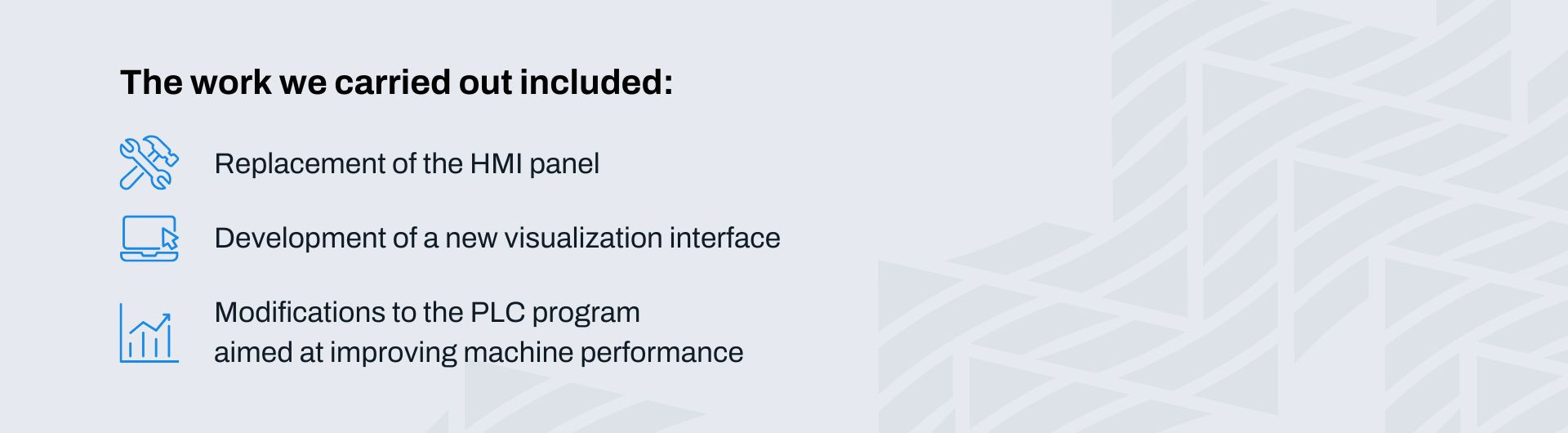
In response to these challenges, we carried out a three-stage modernization process: replacing the HMI panel, creating a new visualization interface, and introducing PLC program changes aimed at improving the machine’s performance.
How Modernization Improved Machine Diagnostics
As part of the new HMI visualization, we introduced several enhancements to increase system clarity and usability:
- We created graphical schematics to help the operator locate the problem (e.g., which specific drive is reporting a fault and where it is located).
- We developed screens that allow authorized users to inspect each glue dispenser individually.
- We designed a layout showing which doors are open and which safety buttons are triggered or not confirmed.
- We expanded the existing alarm system.
As a result, the machine became significantly more "transparent" for operators and service technicians, which led to faster response times and increased production line availability.
Impact of Modernization on Production Efficiency
During the upgrade, we also focused on improving the machine’s performance to better match current production needs:
- We expanded the access rights of authorized users to adjust drive parameters — including initial and end positions as well as motion parameters such as speed and acceleration.
- We enabled product changeovers without having to stop the machine.
- We introduced continuous monitoring of the time intervals between products on the line.
We also added a backup function that allows authorized users to save recipe copies. This improves process security and simplifies change management.

Key Benefits of Machine Modernization
The benefits of modernization depend largely on the scope of the work performed. In this particular project, our goal was to improve performance, simplify diagnostics, and enhance operator ergonomics. As a result, the line’s efficiency increased by 18%, and operating the machine became significantly easier and more intuitive.
Other advantages of machine modernization include:
- Improved product quality
- Reduced operating costs
- Enhanced safety
- Extended machine lifespan
- Increased functionality and greater production flexibility
Machine Modernization Services at ADEGIS
Replacing the HMI, creating new visualizations, and modifying control programs are just part of what we offer. Our services also include complete control system replacements with program code conversion, upgrades of outdated drive systems, and design and implementation of new drive configurations. The scope of modernization is determined after conducting an on-site audit, and upon completion, we provide full documentation compliant with EU Regulation 2023/1230 on machinery.
If you're looking to boost machine efficiency, improve safety, or expand system functionality — you can count on our support. Thanks to our advanced service infrastructure, we not only modernize machines but also help maintain their components in excellent condition.